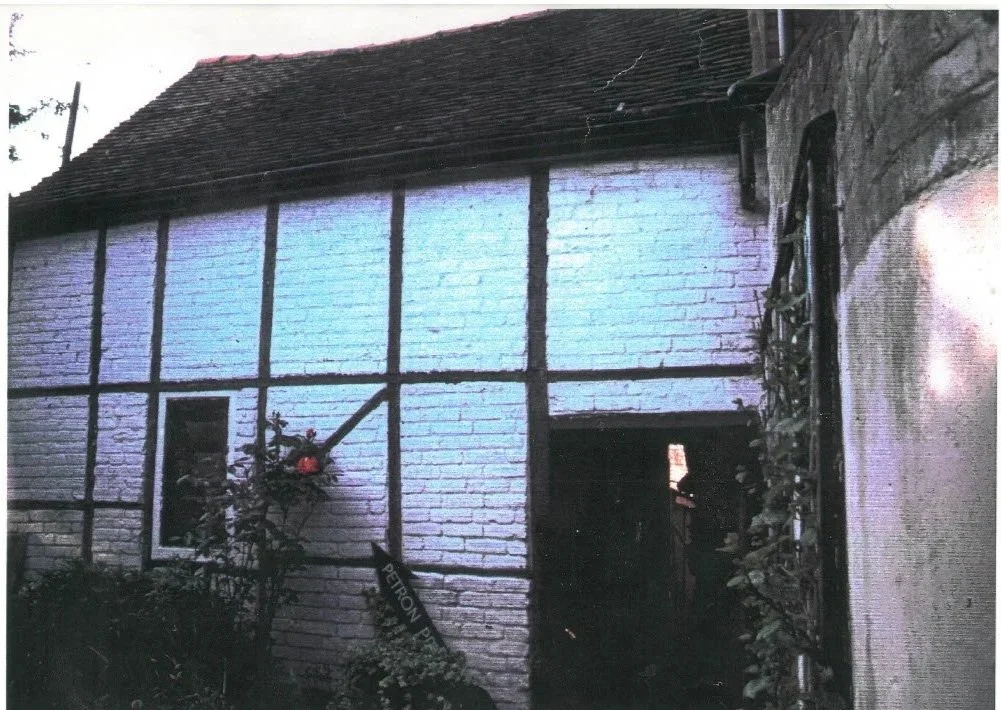
Exterior of Aylesbury Saddler’s Workshop
Tucked away behind Dennis’s leather and travel goods shop in Kingsbury Square, Aylesbury, once stood a modest timber-framed workshop with a long and industrious history. Built around 1773, this small building served generations of local craftsmen and farmers before finding a new future at Chiltern Open Air Museum.
Today, carefully dismantled and preserved, it remains in store, representing the working heritage of Buckinghamshire’s market towns and the skilled trades that supported rural life across the Chilterns.
Original Location
The workshop stood behind Dennis’s shop in Kingsbury Square, Aylesbury, Buckinghamshire. Although hidden from the main street, it formed part of the town’s commercial heart. Its position reflects the practical arrangement of eighteenth-century market towns, where specialist trades often operated behind shopfronts while still remaining closely connected to daily commercial activity. From this small yard space, saddlers supplied and repaired essential equipment for farmers, carters and local businesses.
Dismantling and Rescue in 1989
By the late 1980s, Listed Building Consent had been granted for demolition because the structure was considered unsafe. Rather than see it disappear, COAM stepped in to secure its survival.
The building was carefully recorded and numbered in June 1989 before being dismantled between 26 June and 17 August 1989 by Museum staff and volunteers. Each timber was individually documented so that the workshop can be faithfully reconstructed in the future. Through this detailed process, a working building that might otherwise have been lost was preserved for interpretation and display.
A Craftsman’s Workshop
The structure is timber-framed with brick infill panels and a clay peg-tile roof. The timbers are predominantly oak, demonstrating traditional eighteenth-century construction techniques. Originally built against an adjoining structure, the workshop was later extended at the opposite end at ground floor level, adapting as the business evolved.
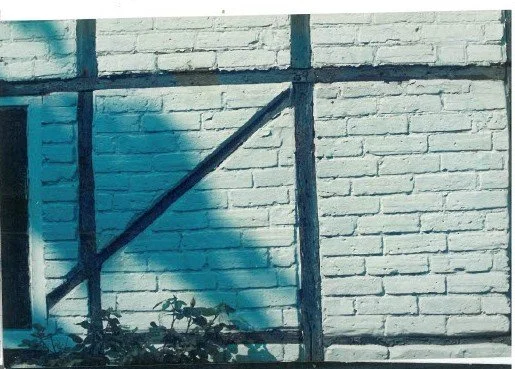
Close up image of Brick infill panels
Inside, the layout clearly revealed its working purpose. Workbenches lined the ground floor beneath three small windows, allowing natural light to fall directly onto tools and materials. Immediately behind the loft stairs stood a substantial wooden block used for shaping horse collars, a central task in the saddler’s trade. The staircase itself appears to have been relocated at some point, showing how the building adapted over time.
At the rear, a coke-fuelled Tortoise stove stood in one corner with its flue passing through the back wall, providing essential warmth in winter. The floor was probably tiled, creating a hard-wearing surface suited to a busy workshop. Two bricks set into the front wall bear the initials “W.N.” and “T.S.”, small but intriguing traces of the individuals connected to the building’s construction or alteration.
A History of Local Craftsmanship
For nearly two centuries, the building functioned as a saddlery. The first known occupier was a Master Saddler named Sirrett, although little is recorded about the earliest decades. In the early twentieth century, Mr H. Wheeler of Hereford began trading from the premises.
In 1928, the business was purchased by Aubrey Dennis. Dennis had been apprenticed to Mr Goss at Waddesdon before becoming an improver with Mr Wheeler, continuing a strong tradition of skilled training within the trade.
During the Second World War, Aubrey Dennis and his staff worked almost seven days a week repairing harness and reaper binder sheets for local farmers. Their work was essential in maintaining agricultural production at a time when machinery, horses and labour were all under strain. The workshop remained in use as a saddlery until the 1950s, when Aubrey Dennis retired.
After its commercial life ended, the building found new uses. It served as a children’s playhouse and later as a factory for archery products, reflecting the changing character of small-town industry during the twentieth century.