
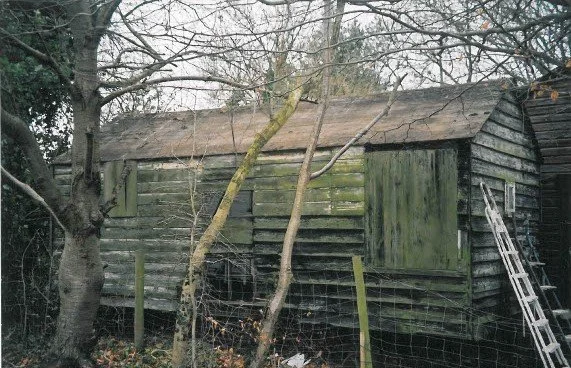
Exterior of Little Gaddesden Living Van
Standing quietly beside a Scout hut behind the Village Hall at Little Gaddesden, Hertfordshire once stood a large and characterful living van. Practical, mobile and robustly built, it represents a way of life that was once common across rural estates.
Now in storage at Chiltern Open Air Museum, the Little Gaddesden Living Van is an important reminder of temporary rural accommodation and estate working life in Hertfordshire.
Dismantling and Rescue in 2001
In early 2001, the site was required to provide access to a new building. The owners were keen for the van to be preserved rather than scrapped, and COAM agreed to take it into its collection.
Because of its size and condition, it could not be transported in one piece. Instead, it had to be carefully dismantled into sections small enough to be loaded onto a lorry. This work was undertaken by Museum volunteers under staff supervision on 10 and 11 February 2001. Through careful planning and teamwork, the van was successfully relocated and saved.
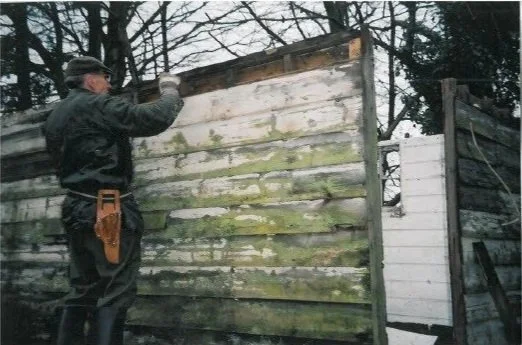
Little Gaddesden being de-constructed for removal
A Substantial Mobile Home
The living van is impressive in scale, measuring approximately 20 feet long, 8 feet 4 inches wide and 9 feet high, excluding the wheels. It sits on a heavy wooden articulated chassis fitted with cast iron wheels, designed for durability and movement across estate tracks and fields.
The structure is built with a softwood frame and clad externally in tarred feather-edge boarding, providing weather protection. A corrugated iron roof adds further practicality and resilience. Inside, the van is lined with horizontal tongued and grooved boarding finished with decorative beading, creating a surprisingly neat and comfortable interior space.
Originally, the van was constructed with one large door on one side, five windows to admit light and ventilation, and an internal partition dividing the space. Its layout suggests it was designed not just for shelter, but for longer-term occupation.
A Gamekeeper’s Home?
Although the exact date of construction is not known, the van is thought to have served as accommodation for a gamekeeper, possibly connected to the nearby Ashridge Estate. Structures of this kind were often provided for estate employees such as gamekeepers, shepherds and other rural workers who needed to live close to their duties.
Living vans offered practical and adaptable accommodation. Because they were mounted on wheels, they could be relocated as work shifted across an estate, whether for seasonal tasks or changing management needs. In this way, they occupied a middle ground between permanent cottages and makeshift shelters, reflecting the flexible nature of rural employment.
On larger estates, particularly those with extensive woodlands or remote coverts, temporary or semi permanent accommodation was often necessary. Woodland huts were commonly simple timber or brick buildings positioned deep within managed landscapes. They allowed keepers to remain close to pheasant pens, rabbit warrens or deer parks, especially during breeding or shooting seasons, and typically consisted of a single room with a stove and minimal furnishings.