
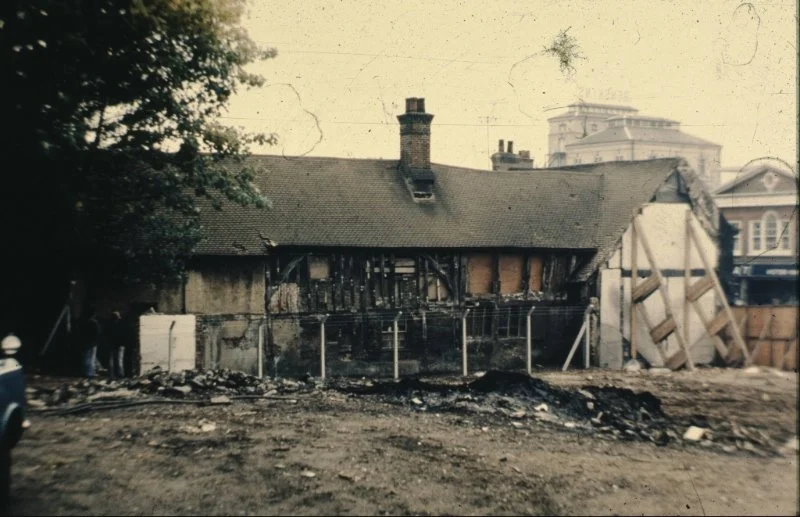
View of 177 High Street, Watford from behind
In the late 1970s, major redevelopment reshaped parts of Watford town centre. Road improvement schemes led to the demolition of several historic buildings along the High Street. Rather than being lost entirely, 177–179 and 193–195 High Street were meticulously dismantled and moved to COAM, where they remain in store awaiting re-erection.
Both properties once stood within Watford’s historic commercial centre, reflecting centuries of trade, industry and adaptation. Thanks to careful intervention, significant portions of these medieval timber-framed buildings were saved. Today they form an important part of our commercial buildings in store and represent rare survivals of fifteenth-century urban architecture in Hertfordshire.
195 High Street: A Medieval Town House with Commercial Roots
195 High Street is a fifteenth-century timber-framed town house, dating to around 1450. It was originally constructed as a two-storey building with a jettied front, a feature typical of late medieval urban architecture where the upper floor projected over the street below. One end of the ground floor formed a wagon way, allowing carts and goods to pass through, a clear indication of its commercial function. Around 1500, a rear extension was added, expanding the building’s footprint and capacity. Both roof structures are of crown post construction, a distinctive medieval form that survives within the stored timbers today.
In the nineteenth century, the original jettied frontage was replaced with a brick shopfront, reflecting changing fashions and retail requirements. By the time of dismantling in April 1979, following a Public Inquiry that granted Listed Building Consent on the condition the timbers were saved, the property was operating as Stapletons Tyre Depot. Yet earlier layers of its history were uncovered during dismantling, including baking ovens in the cellar that revealed its use as a bakery in the nineteenth century. Like many High Street buildings, the ground floor interior had been altered significantly in the twentieth century to accommodate modern retail, while the medieval structure survived above.
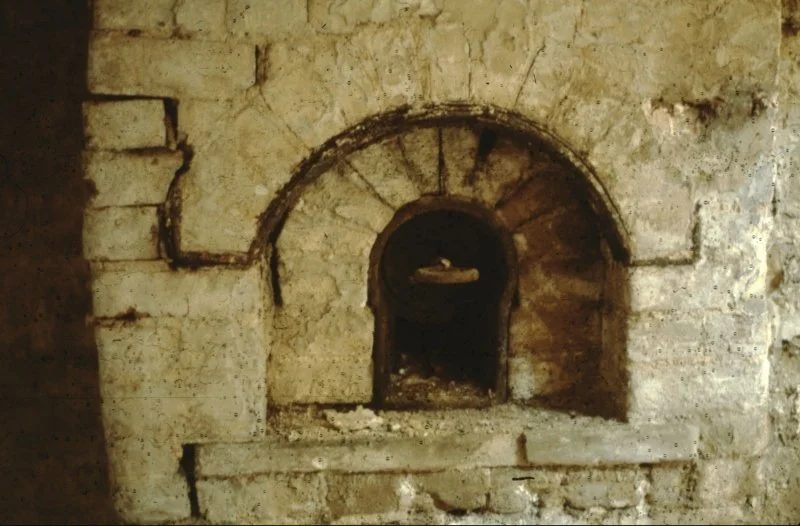
Bakers Oven found in the cellar of 195 High Street
177–179 High Street: A Medieval Warehouse
177–179 High Street was dismantled slightly earlier, in June and July 1978, during the same programme of redevelopment. Although demolition was permitted, the building was recognised as being of historic interest and worthy of preservation. Specialist contractors, overseen by Museum Director Paul Simons, carefully recorded and dismantled the structure. Only the rear wing came to the Museum, while the front range was reconstructed in Verulamium, St Albans.
The surviving rear wing is believed to date from the fifteenth century and is the oldest part of the complex. Originally, its ground floor was undivided, spanned by substantial ceiling beams with arched braces, suggesting an open and functional interior. The roof is primarily of crown post construction, with a king post in the west gable, while the east gable was rebuilt in the nineteenth century. Although parts of the ground-floor framing had been replaced with brickwork over time, enough timber survived to demonstrate its medieval construction. The building was probably erected as a warehouse, quite possibly for storing cloth, reflecting the importance of textile trade in the region during the late Middle Ages.
Crown Post Construction: A Shared Medieval Feature
Both buildings share the important architectural feature of crown post roof construction. This distinctive medieval roof form, common in the fifteenth century, uses a central vertical post rising from a tie beam to support a collar purlin. It is characteristic of substantial timber buildings of the period and provides valuable evidence of skilled craftsmanship. The survival of two crown post structures from Watford High Street is exceptional and offers insight into the commercial character of the town in the late medieval period.
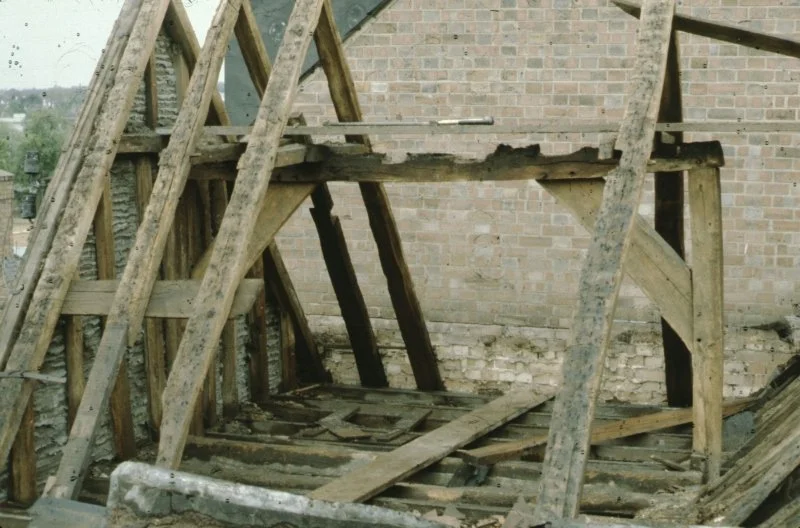
View of timberwork and crown post in 195 Watford
From Demolition to Preservation
The story of 177–179 and 193–195 High Street reflects changing attitudes towards heritage in the twentieth century. Although redevelopment proceeded, conditions ensured that the medieval timbers were carefully dismantled, recorded and preserved rather than destroyed. Without that intervention, these rare examples of Watford’s medieval built environment would have been lost entirely. Their survival allows us to explore the commercial history of the Chilterns, from warehousing and cloth storage to bakeries, shops and twentieth-century trade.
In the 1990s, there were plans for the buildings to become a medieval dyeing workshop, with exhibition space upstairs focusing on textile crafts — a theme that continues to resonate with the Museum’s interpretation of regional craft and industry today.