
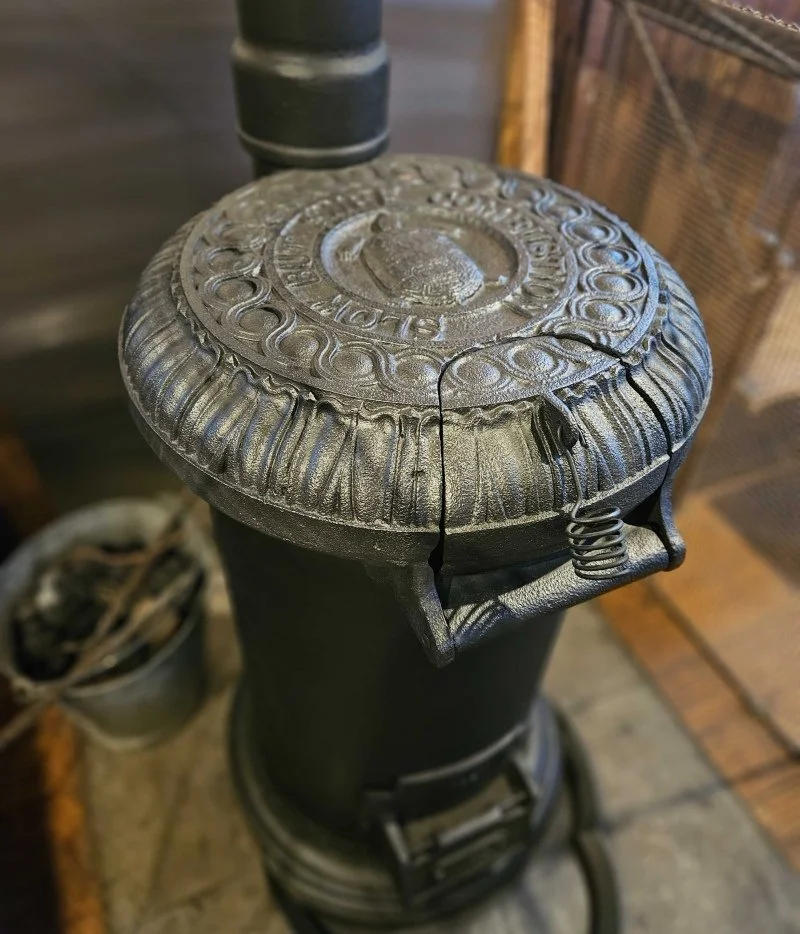
If you’ve visited the Museum before, you’ll know that every building here has its own unique story, and the objects inside help bring those stories to life. The Tortoise Stove in Thame Vicarage Room is no exception. It’s not just a piece of ironwork — it’s part of a long tradition of innovation and everyday ingenuity that helped shape how people heated their homes and workplaces in the 19th century.
The Tortoise stove dates back to 1830, when Charles Portway hand-built the first one to heat his ironmongery store in Halstead, Essex. After making another stove for a neighbour, his wife, Mrs Portway, wisely suggested he turn his new design into a business. He soon established a small foundry, and what began as a practical solution for a cold shop quickly became a national success. Over the next 50 years, more than 17,000 of these stoves were sold, providing reliable and economical heating to thousands of homes, churches, and community buildings across Britain.
So what made the Tortoise so special? Its secret was in the name. Unlike other solid-fuel stoves of the period, the Tortoise was designed to burn slowly and efficiently. It had no grate and was lined with firebrick, meaning it extracted the maximum amount of heat from each filling of fuel. Portway’s design philosophy was summed up in the stove’s motto: “Slow but sure.” This made it one of the very first heating appliances to advertise economy and efficiency as selling points — something we still value today.

The Tortoise Stove wasn’t just a domestic heater, either. It was adapted for all sorts of uses, from laundry and harness-room stoves to models built for churches and public halls. As time went on, the design was gradually refined to improve performance and meet new safety standards, remaining in production well into the 20th century.
The Museum’s Tortoise Stove in the Thame Vicarage Room is a wonderful survivor from that long line of craftsmanship. After careful restoration, it has now been reinstated to its rightful place, where visitors can see it as it would have looked in a working Victorian school room. Its quiet presence reminds us not only of the comfort it once provided but also of the simple, ingenious idea that made it famous nearly two centuries ago — that slow and steady really does win the race.