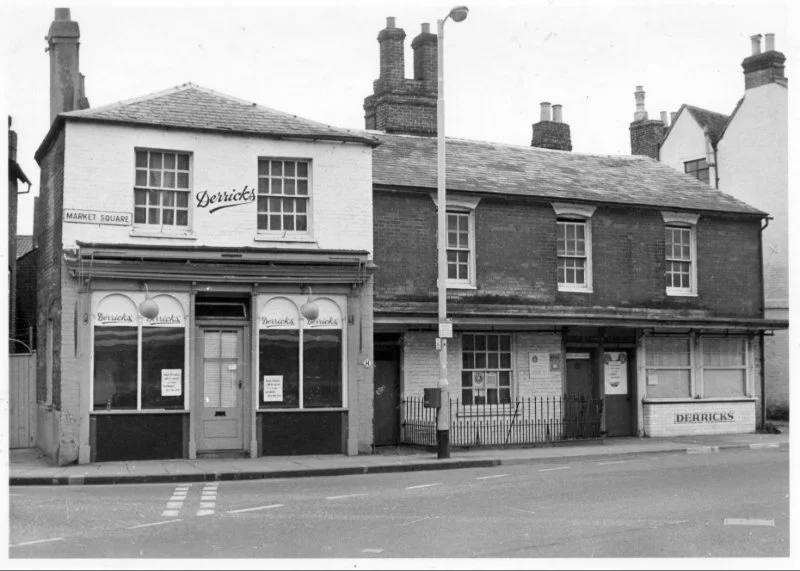
Outside 4-6 Market Square, Chesham
Historic towns are constantly shaped by change. New roads, new industries, and new ways of living can transform familiar streets in ways that are sometimes welcomed and sometimes deeply controversial. In Chesham, the later twentieth century brought one of the most significant physical changes the town had experienced for generations. Plans to ease growing traffic congestion would reshape parts of the historic centre, leading to the demolition of several long-standing buildings. Fortunately, not all of these structures were lost. 2 and 4-6 Market Square and 14, 16-18 Church Street were all moved to COAM, and now sit awaiting reconstruction.
A New Route through Chesham
By the 1960s, traffic along the High Street of Chesham had become unbearable and a solution was urgently required. However, the position of Chesham between two hills and a lake, Skottowes pond, to the West meant that options were limited. In 1968, as Phase 1 of a multi-phase plan, a relief road, St Mary’s Way, was constructed to the West, between the town centre and Skottowes Pond; this took traffic heading North, while Southbound traffic continued to use the High Street.
However, it quickly became clear that this solution was insufficient and, after much consideration, the decision was reached to implement Phase 2: widening St Mary’s Way into a two-way road. This decision did not meet with universal approval; it meant demolishing a number of buildings and cutting through one of the old streets, Church Street, effectively isolating part of the old town from the centre. Despite this, in 1989, the work went ahead and the High Street was pedestrianised.
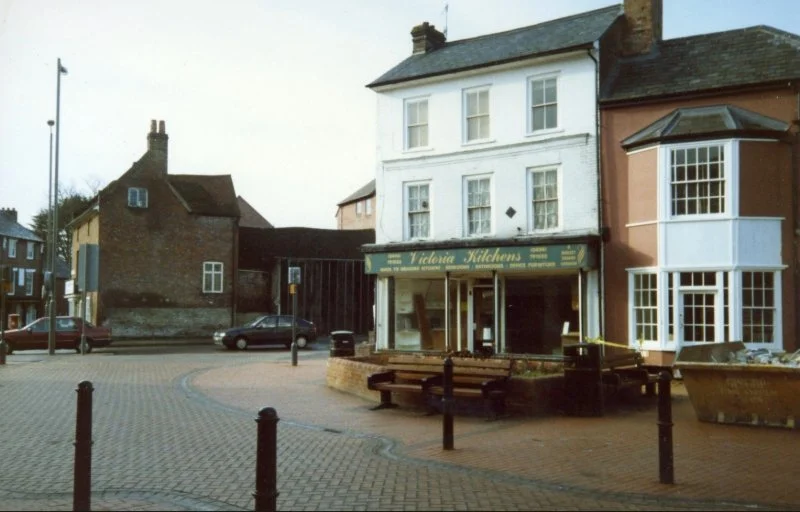
Location where Chesham buildings had previously been prior to dismantling
At the South end of Chesham, Red Lion Street was extended into the Market Square to meet St Mary’s Way and two of the buildings demolished here, numbers 2 and 4-6 (shown in the photographs), were removed to the Chiltern Open Air Museum for storage and later reconstruction. Further along, St Mary’s Way cut across Church Street and several buildings were demolished here. While number 14 was being taken down, an old baker’s oven was discovered and this was taken to COAM. Also, part of a coachworks behind the buildings at numbers 16-18 were taken.
2 Market Square: Chesham Shop
Many people and groups, including the Chesham Society, considered that the demolition of the buildings in Market Square was unnecessary and argued for them to be kept or relocated. They were listed buildings but were in a poor state of repair as they had been neglected following the initial publication of the Council’s road proposals. Some argued that the cost of repairing them would be worthwhile but they could not be saved.
The shop at 2 Market Square is considered to be of architectural interest because it is a ‘bent’ rectangle. It dates from the nineteenth century and is built of red bricks with a gabled roof and two large shop windows in the front. By the time the building was demolished, much of the downstairs had been removed to make one large shop area but there were five rooms on the first floor, which was reached by a timber spiral staircase.
Little is known of the early history of this shop but, by the beginning of World War II, it was a Pork Butcher’s, owned by Mr Derrick. One local resident remembers her aunt regularly making the eight-mile journey from Chalfont St Giles to this shop during the war to buy chitlins and other offal meats which were not rationed. Later, the shop became Chesham Automatics and, by the time of its demolition, was trading as a Chinese take-away, A-way-fare.
4-6 Market Square: Butcher’s Shop
The building at 4-6 Market Square is timber-framed and stood parallel to the road with a 16th century building at right angles behind no. 6. It has brick infill panels and a clay peg tile roof. Both parts of the building had a Victorian front, added in 1843, built of brick with sash windows and a slate roof. When demolished, the shop at no.6 still had this original shop front. In front of the shop was a white glazed brick wall up to window-sill height, topped with a marble slab. The name ‘ARCHER’ was picked out in blue.
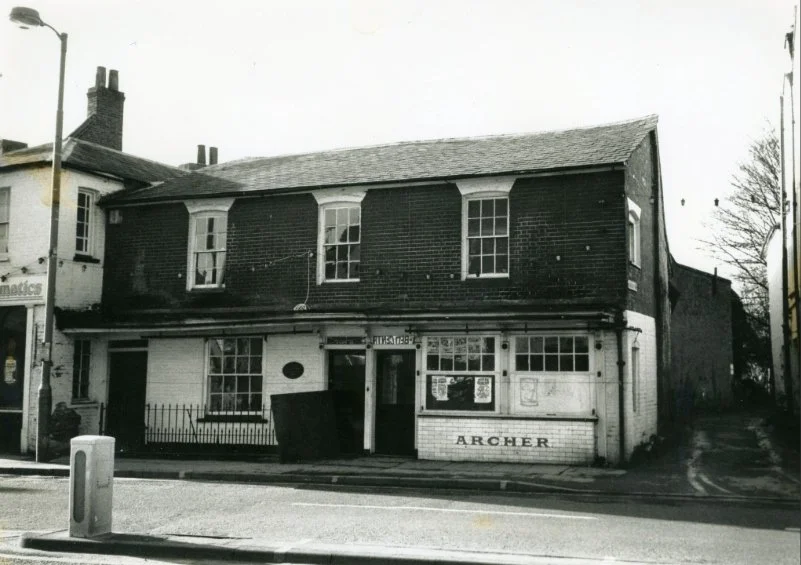
It seems likely that no.4 was always a residential building and it is known that no.6 was a butcher’s shop from at least 1830. At that time, the butcher was Thomas Climpson, who was succeeded in 1864 by his wife Charlotte and then by his son, George. In 1877, Charles Archer was recorded as the butcher and, in 1899, the business was taken over by William Gomm. The business was sold to Mr Derrick in 1948 and he ran it together with his shop at no. 2 until the buildings were compulsorily purchased by the council in 1971. During this time, Mr Gomm continued to live at no. 4.
Until a short time before its demolition, the building at no.6 was used as a charity shop for the Sue Ryder Foundation.
14 Church Street: Bakers Oven
The old baker’s oven discovered behind 14, Church Street is of historical interest, partly for itself and partly as a link with Chesham’s oldest existing bakery, which has been in business for almost two hundred years.
In June 1838, William and Sarah Darvell opened their bakery at 14, Church Street. Business flourished and, in 1906, they opened a second branch at 28, High Street. Just six years later, they moved next door to number 30 and built a new bakery behind the shop, with an entrance through Lum’s Yard. At this time, it seems that they closed the original bakery in Church Street. Over the years, the business has been passed down through the family and Darvell’s is still a well-regarded bakery in Chesham; however, the oven at 14 Church Street lay forgotten for many years until the demolition of the building in 1989.
The oven is built of brick, with cast-iron fittings and with a wooden floor over the top. It measures approximately 12 feet square and 8 feet high. One of the castings is dated 1789 and had been rebuilt. Another contains two inscriptions:
“POWELL & SON, NO. 47 LISLE STREET, LEICESTER SQUARE”, together with a Royal coat of arms and “T. POWELL, INVENTOR OF OVENS heated with coals”.
When the team from COAM dismantled the oven, they were only able to take the top, vault and facing bricks from the oven; the brick ‘core’ of the oven itself was too heavily burnt to take apart.
16-18 Church Street: Coachworks
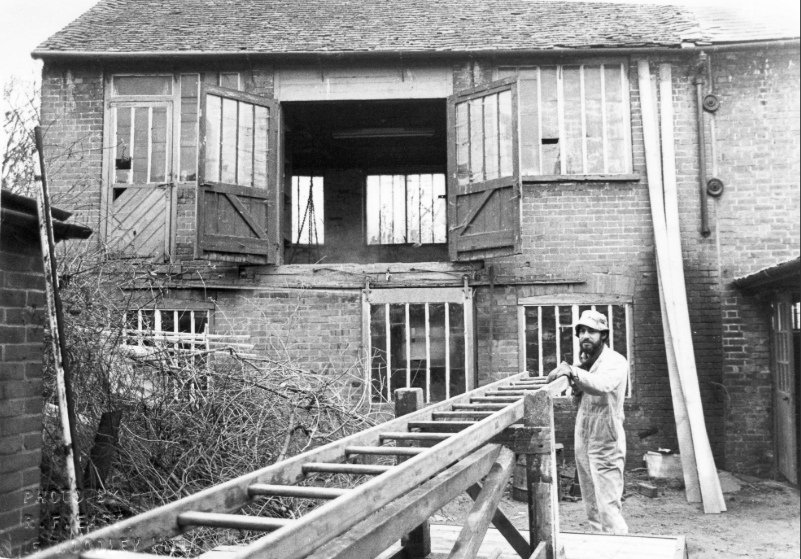
Behind the building next door, 16-18 Church Street, shown in the photograph, was the workshop of Chesham Coachworks. Records show that this was built in 1847 and initially owned by William Barnes of Whitechapel. At some time in its history, it had been extended and COAM took the original half for later re-erection at the museum.
From 1855, the building was occupied by James Barnes, a wheelwright already established in Church Street. At this time, his business may have been making and repairing wheels and agricultural items but, by 1863, he was describing himself as a coachmaker. His was a small family business comprising himself and his two sons, both wheelwrights, and one other employee. However, over the years, business flourished and, in 1870, James bought the building from William Barnes for the sum of £340. Ten years later, he employed six men and three boys. By this time, the business had outgrown the premises and an extension was built on the west side.
Despite some setbacks, including a serious fire, the business continued to thrive. It developed into a business painting and trimming ‘motor bodies’ and remained in the Barnes family until 1954 when it was sold to a Mr Seymour. He used the building as a joiners’ shop and was the owner just before it was dismantled. Fortunately, though, he left much of the contents undisturbed and many items relating to the coachworks business were found when the building was dismantled. One item of particular interest was a photograph of the building with the sign of Barnes and Sons over the entrance; during clearing of the building, a painted sign for Seymour Builders was discovered and this seems to be the repainted sign from the original photograph.
The building itself is two storeys high, built of soft red bricks with a gabled roof of clay peg tiles. It measures about 26 foot long and 17 foot wide. It was accessed by means of an archway through No.16. There were a pair of double doors on each floor of the building, the ground floor ones operating on a sliding track system while those on the first floor were hinged. This can be clearly seen in the photograph.
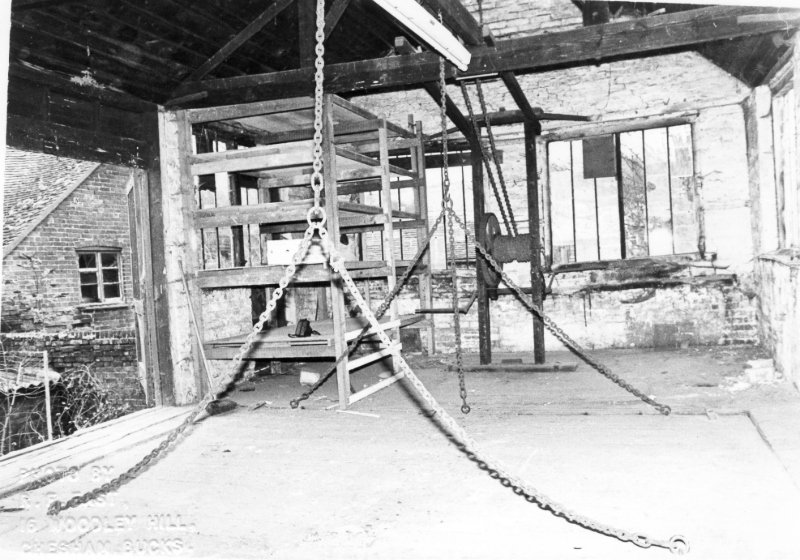
Lifting platform to transfer coaches/carts from one floor to another
Outside, a wooden staircase led to the upper floor, but there were no internal stairs. Access to the first floor for vehicles was obtained by the raising and lowering of the central portion of the floor, using a chain and pulley system (see photograph). It is likely that coaches and carts were built or mended on the ground floor, then could be raised to the first floor for painting and varnishing. This arrangement meant that the first floor could be shut off from the ground floor to achieve the dust-free environment necessary for this type of work. Nine large windows on the first floor also allowed for plenty of light, needed for intricate painting.
We are lucky to have been able to save this traditional coachworks, the oven and the shops, which provide a fascinating glimpse into Chesham’s history.