
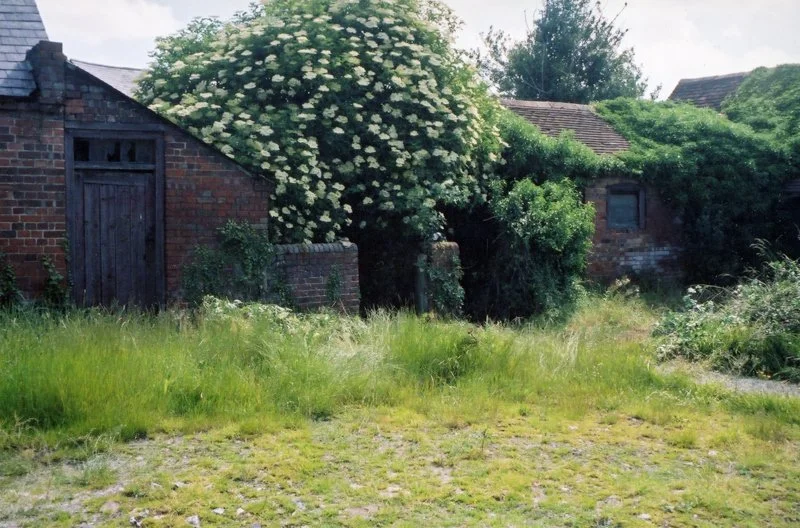
Outside the overgrown Princes Risborough Pigsties
Nowadays, the farming of pigs goes largely unnoticed, although we might sometimes see a field of them snuffling about or lazing in the sun, as part of a commercial pig-farming enterprise. However, for most of history, pigs were kept by individual cottagers or small-holders.
Pigs and Working-Class Self-Sufficiency
In Victorian times, keeping a single pig was a wide-spread practice among working-class families, providing an important means to assist self-sufficiency. A pig could be housed in a small sty in a family’s backyard and fed on food scraps which would otherwise go to waste. In this way, the pig was a useful waste-disposal system and, when slaughtered in the autumn, it provided valuable meat which could be preserved to feed the family over the winter or shared with neighbours. Even as late as during the Second World War, keeping a pig was a useful way of supplementing the household finances.
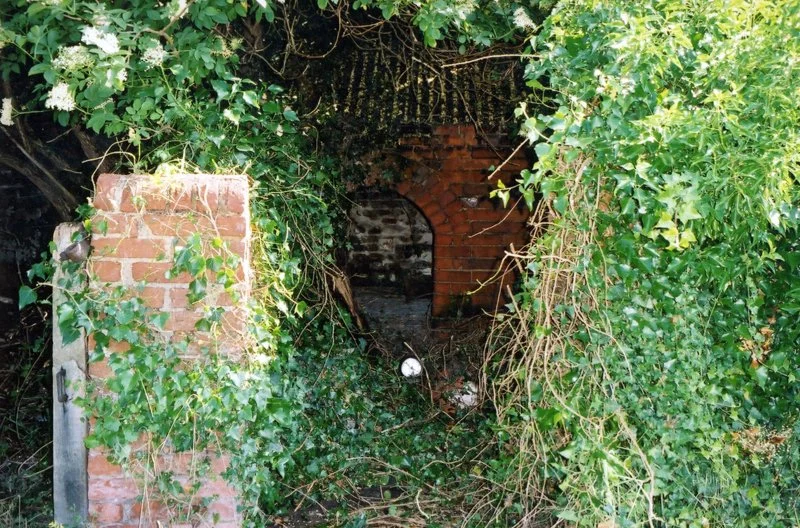
Looking into Pigsties
The Victorian Pig Sties at COAM
At COAM, we have in store a pair of typical Victorian pig sties recovered from Town Farm in Princes Risborough. These sties were constructed of brick, with cobbled floors and originally with a clay peg-tile roof, although this was replaced with corrugated asbestos. They were constructed against a boundary wall, using the walls of two other buildings as part of their structure and two yards were built at the front. It is thought that the sties were built in the mid-1800s although the exact date of construction is unknown.
Large White pigs were normally kept at the farm, with the sow housed in one sty and her weaners in the second for fattening. One of these weaners would be retained and slaughtered on the premises to provide meat for the farmer’s family and workers, while the others were sold at market.
Town Farm and the Stratton Family
In the eighteenth and nineteenth centuries, Town Farm formed a major part of the holdings of the Stratton family, who were prominent citizens and land-owners in the area. In 1898, it extended to some 148 acres, scattered around the periphery of Princes Risborough, which was then a village. At that time, the owner, George Stratton, granted the tenancy to Rupert Wood. As part of the tenancy agreement, a number of thatched buildings on the farm were to be removed and replaced with more modern buildings with “crinkly tin roofing”.
Changes in Ownership and the Loss of Farmland
In 1922, at the start of the Agricultural Depression, Rupert Wood was served with a Notice to Quit or offered an option to purchase the farm. He chose the latter course and his family continued to farm there. However, in 1948–1952, a major portion of the land was compulsorily purchased by Wycombe District Council for the building of council houses.
The family continued at Town Farm until the turn of the century, when the remaining land was sold for housing development. The preservation of the sties was made a condition of the granting of planning permission. In 2002, they were removed to COAM.
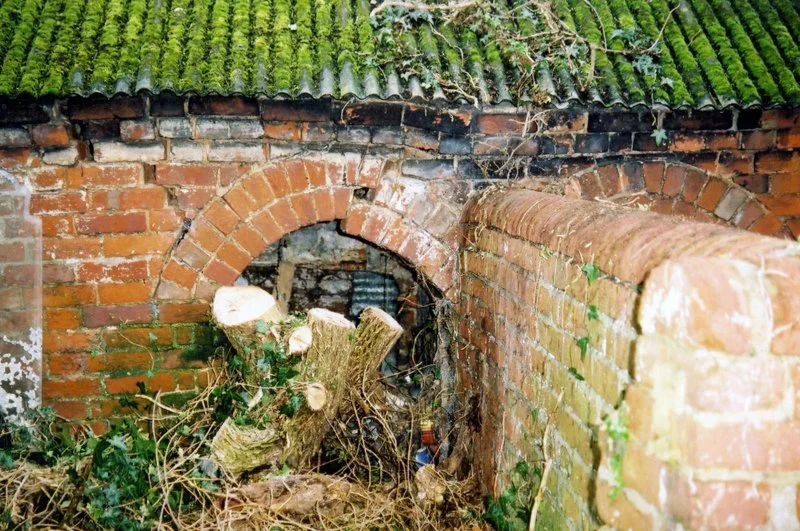
Tree growing through middle of pigsties
Preserving an Important Piece of Social History
By this time, the sties had not been used for a number of years and, as the photograph shows, were somewhat overgrown with ivy, with an elder tree growing in the entrance to one and distorting the wall. This meant that they were hard to remove and it was not possible to remove the back wall or the end wall of the right-hand sty. However, the remainder of the structures was taken into storage and it is hoped that this will, in the future, be re-erected to provide a record of an important feature of our social history.