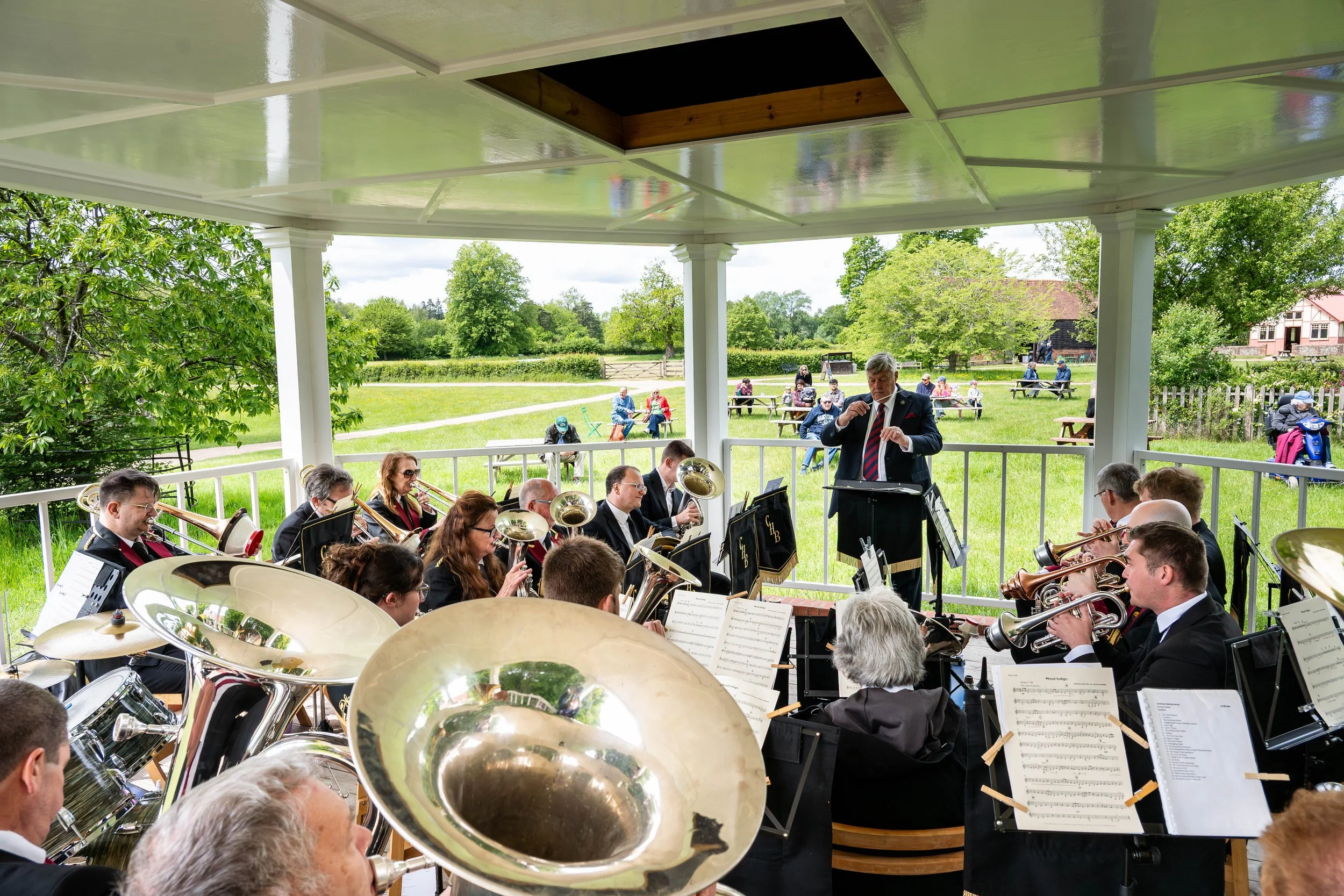
Chiltern Hills Brass playing on Finsbury Circus Bandstand at Chiltern Open Air Museum in May 2026
Have you ever wondered where bandstands came from — or why they were once called band houses?
Today, a bandstand might bring to mind sunny afternoons in the park, live music, picnics and perhaps a spot of dancing. But these much-loved features of our parks and public spaces have a fascinating history stretching back more than 160 years.
From band houses to bandstands
The first recorded band house was built in 1861 at the Royal Horticultural Society’s gardens in South Kensington, London. At the time, public parks and gardens were opening across the country, giving people somewhere to enjoy the fresh air, beautiful surroundings and a little entertainment too.
And what better way to entertain a crowd than with live music?
By the end of the 19th century, octagonal bandstands had become a familiar sight in parks, on piers and along seaside promenades. The growth of the British brass band movement, together with improvements to public parks, meant that bandstands became incredibly popular.
At their height, there were more than 1,500 bandstands across Britain, with some attracting crowds of up to 10,000 people!
The Victorians were also great believers in the benefits of music and fresh air. They thought that listening to good music could lift the spirits, improve moral health and even help clear the mind of the grime and stresses of rapidly growing industrial towns and cities.
So, a trip to the park for some music wasn't just entertainment — it was considered good for you!
What happened to all the bandstands?
Sadly, the golden age of the bandstand didn't last forever.
Between 1945 and 1980, nearly 600 bandstands disappeared. Some were scrapped during and after the war, while others were simply left to deteriorate as maintenance became expensive and people's leisure habits changed.
Then, during the 1980s and 1990s, neglect of many urban parks led to even more bandstands being demolished. Before long, the number of surviving bandstands in Britain had fallen below 500.
Luckily, some have been saved — and we're delighted that one of them has a new home here at Chiltern Open Air Museum.
The Finsbury Circus Bandstand
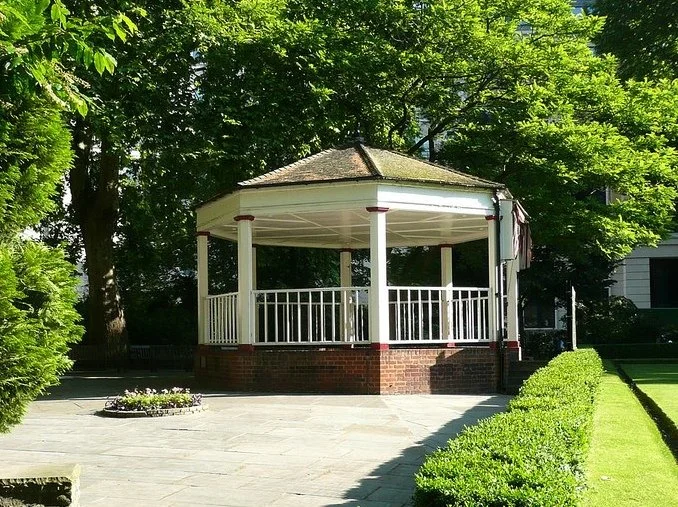
The bandstand at Finsbury Circus Gardens
Our bandstand began life in London's Finsbury Circus Gardens. Built in 1955, it stood in one of the capital's most historic green spaces.
Finsbury Circus was originally laid out in 1815 to a design by George Dance the Younger, a celebrated architect and town planner. He was responsible for creating elegant, formal green spaces in the heart of London, using symmetry and carefully planned planting to bring a touch of beauty to the busy city.
The gardens themselves have an even older story. They stand on what remains of Moor Fields, London's first public park, which dates back to 1607.
And Finsbury Circus has had a few close calls over the years! Between 1860 and 1865, there were plans to demolish the gardens to make way for a railway station. Thankfully, public protests helped save them. A few years later, in 1869, the Metropolitan Railway tunnelled beneath the gardens.
More recently, the bandstand faced another challenge when the area was needed for Crossrail. A huge 42-metre access shaft was constructed as part of the work for the nearby Elizabeth line station at Liverpool Street, meaning the 1955 bandstand had to be moved.
That's where its story with us begins.
A new home at Chiltern Open Air Museum
Rather than allowing this piece of London's history to disappear, the bandstand was rescued and rebuilt here at Chiltern Open Air Museum.
After a decade of rolling closures and major works, Finsbury Circus Gardens officially reopened on 4 June 2025, following a £2.8 million transformation project led by the City of London Corporation.
Just over a month later, on 17 July 2025, our bandstand had its own special moment when it was officially opened at the museum by Countess Howe, His Majesty's Lord Lieutenant of Buckinghamshire.
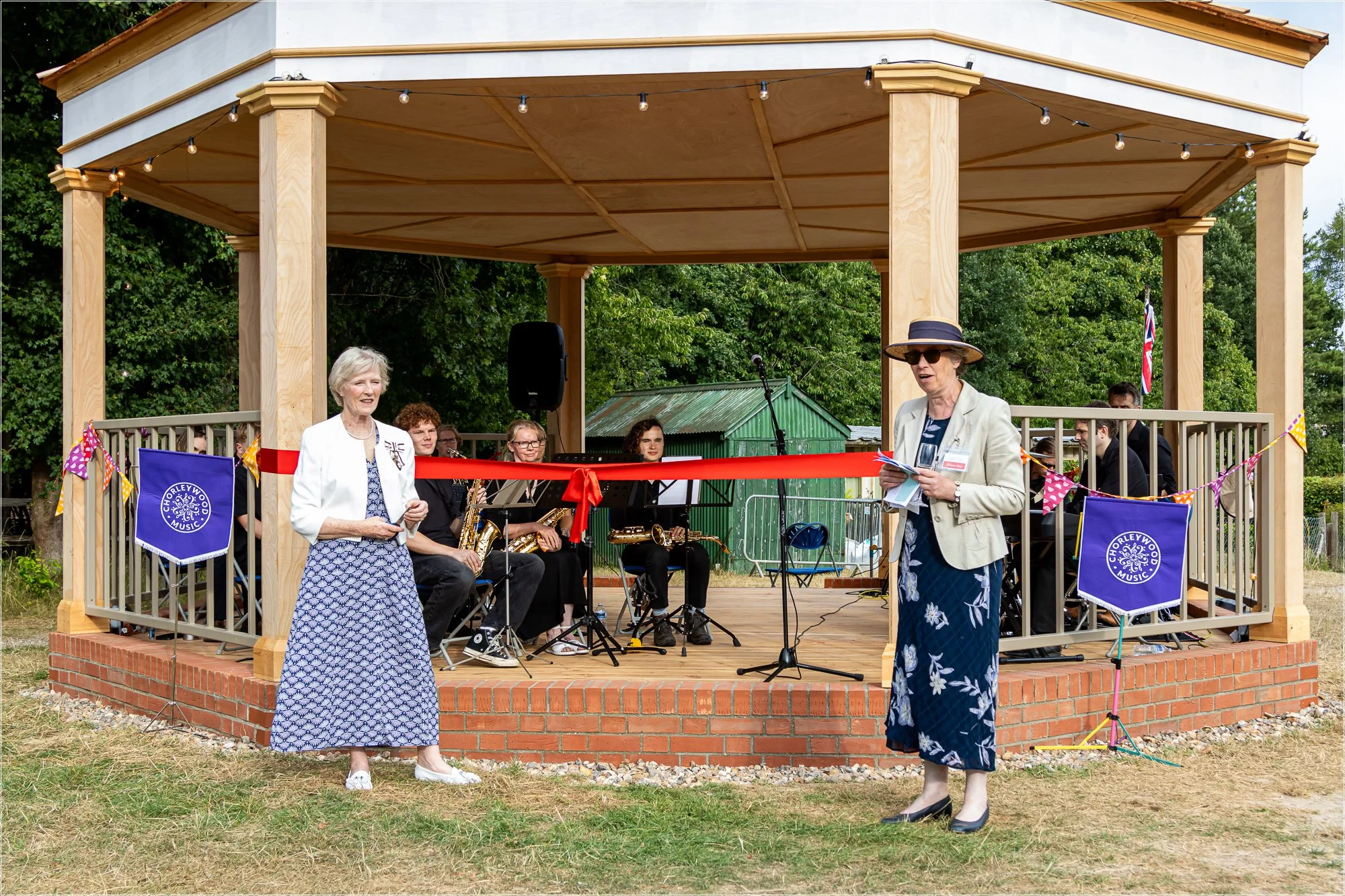
Countess Howe, His Majesty’s Lord Lieutenant of Buckinghamshire (left) and Verena Clark, Chair of Trustees at COAM, at the opening of the Finsbury Circus Bandstand at Chiltern Open Air Museum in July 2025.
And, of course, a bandstand isn't really a bandstand without music!
Since opening in 2025, our bandstand has already welcomed performances from Chorleywood Jazz, Chiltern Hills Brass and RAF Halton's Voluntary Band.
So next time you're at the museum and hear music drifting across the site, come and take a closer look. You're not just listening to a concert — you're enjoying a little piece of Britain's social and musical history.
Fancy hearing the bandstand in action? Check out our events calendar to see what's coming up and join us for some live music, fresh air and, hopefully, a little sunshine too!