
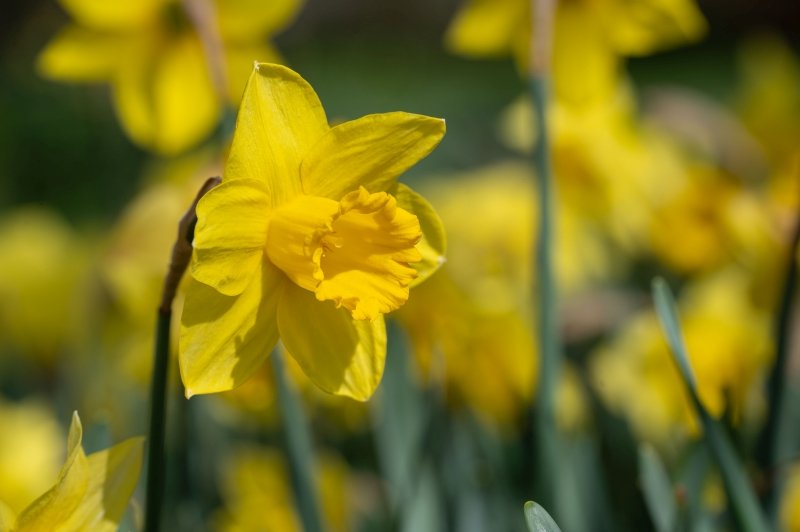
After weeks of bare branches and dull winter colours, the bright yellow flowers of daffodils seem to appear almost overnight, lighting up verges, woodland edges, and gardens. In the Chilterns, where beech woods and chalk hills shape the land, these yellow patches have marked the change of seasons for centuries. Long before modern calendars, flowers like these signalled the end of winter and the start of spring work.
Daffodils are more than just cheerful flowers; they carry many layers of meaning tied to folklore, farming, and faith.
A Native Flower of the Chiltern Countryside
The wild daffodil, Narcissus pseudonarcissus, grows naturally in parts of Britain and Western Europe. It thrives in damp meadows, ancient woodlands, and river valleys, blooming from March to April. In Buckinghamshire and the Chiltern Hills, you’ll often spot wild daffodils along woodland edges and in old grasslands, showing how the land has been used for a long time.
Wild daffodils are smaller and more delicate than the bigger garden varieties. Their soft yellow petals and gently nodding heads fit well in the semi-managed countryside, where wild nature meets human care.
By the eighteenth and nineteenth centuries, daffodils had become popular ornamental plants in estate gardens. Plant breeding improved, and new varieties appeared. Planting them in large swathes across lawns became fashionable in the late nineteenth and early twentieth centuries. This natural look echoed the wider landscape. It blurred the line between garden and countryside.
Folklore and Contradiction
Daffodils are often connected to renewal and good luck. In Wales, people wear them on St David’s Day as a national symbol, representing both identity and the promise of spring. In some parts of England, it was believed that whoever saw the first daffodil bloom would have a lucky year.
But folklore is rarely straightforward. Because daffodils bloom around Lent and Easter, they’ve also been linked to ideas of death and resurrection. Some believed that bringing the first daffodils indoors each year would stop hens from laying eggs. Others thought it was bad luck if the first daffodil you saw faced you directly.
Even the name is unclear. The botanical name Narcissus usually refers to Greek mythology, where the youth Narcissus turns into a flower after falling in love with his reflection. Another explanation links the name to the plant’s toxic nature, since its bulbs contain poisonous compounds. Whatever the origin, the daffodil has long symbolised both beauty and caution.
A Practical Marker of the Rural Year
For rural communities, seasonal change was more than just a pretty sight. When daffodils appeared, it meant lambing, hedge laying, and preparing for spring sowing. Their bloom marked the shift from winter upkeep to fresh growth.
In historic Chiltern villages, people would have seen these changes around cottages, churchyards, and farmyards. Seeing daffodils bloom against timber-framed buildings or along chalk paths signaled a return to outdoor work and longer days.
Daffodils at COAM
Today, daffodils still bloom across the Chilterns, in village greens, churchyards, and woodland clearings. Some are planted on purpose, while others have naturalised over the decades, returning every year with quiet dependability.
At COAM, daffodils remind us that heritage is more than just buildings and objects. The landscape holds memories too. By softening the edges of historic structures, spring flowers reconnect these places to the natural rhythms that shaped the lives of the people who lived and worked there.
Daffodils might seem simple, but their story touches folklore, gardening, and rural life. In their short, bright bloom, they connect us to centuries of seasonal change and the lasting bond between people and nature.