Enid Blyton: Famous People of the Chilterns
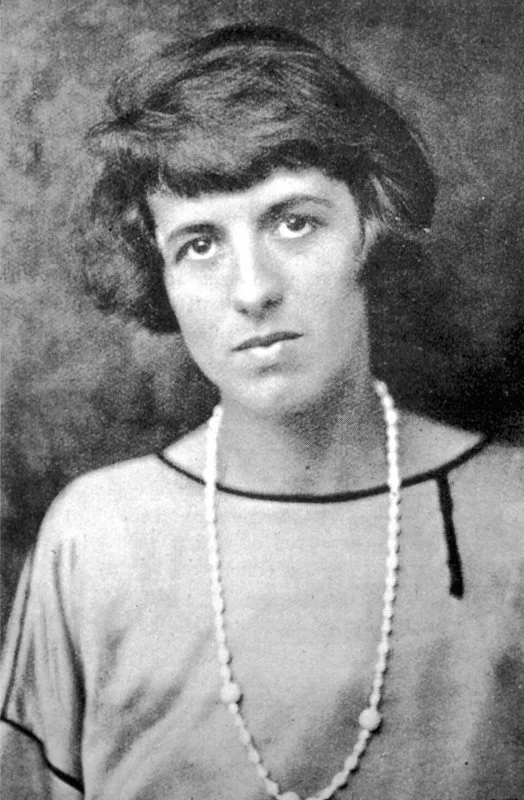
Enid Blyton in 1923 Public domain, via Wikimedia Commons
Enid Mary Blyton (1897–1968) was one of the most prolific and successful children’s authors of the twentieth century. Her stories have captivated generations of young readers around the world since the 1930s, selling more than 600 million copies, and her work has been translated into around 90 languages.
Today, she is best remembered for much-loved series including Noddy, The Famous Five, The Secret Seven, The Five Find-Outers, Malory Towers, and The Faraway Tree. Across her long career, however, Blyton wrote on a wide range of subjects, including education, natural history, fantasy, mystery, and biblical narratives
A Young Writer
Blyton attended St Christopher’s School in Beckenham between 1907 and 1915. She enjoyed sport, becoming the school tennis champion and lacrosse captain, but writing was where she particularly excelled.
In 1911, she entered a children’s poetry competition organised by writer and publisher Arthur Mee. Mee offered to print her verses, encouraging her to produce more, despite her mother reportedly considering it a waste of time and money. Blyton’s first published poem appeared in a children’s magazine when she was just 14.
It was the beginning of an extraordinarily productive literary career.
Famous Five, Mary Mouse and Noddy
The 1940s saw the arrival of several characters and series that would become closely associated with Blyton.
In 1942, Blyton released the first book in the Mary Mouse series, Mary Mouse and the Dolls’ House, which was the first of 23 Mary Mouse books produced between 1942 and 1964 and went on to sell 10,000 copies in 1942 alone.
That same year saw the publication of the first novel in the Famous Five series, Five on a Treasure Island, illustrated by Eileen Soper. It introduced readers to Julian, Dick, Anne, George – short for Georgina and Timmy the dog, characters that would become household names in Britain. The adventures of the Famous Five proved enormously popular and eventually stretched to 21 novels published between 1942 and 1963.
Another of Blyton’s best-known creations, Noddy, first appeared in the Sunday Graphic on 5 June 1949. And Noddy Goes to Toyland, the first of at least two dozen books in the series, was published later that year and became the first in a hugely successful series of stories about the little wooden boy and his adventures in Toyland. In 2003 and 2004, we even hosted Noddy events.
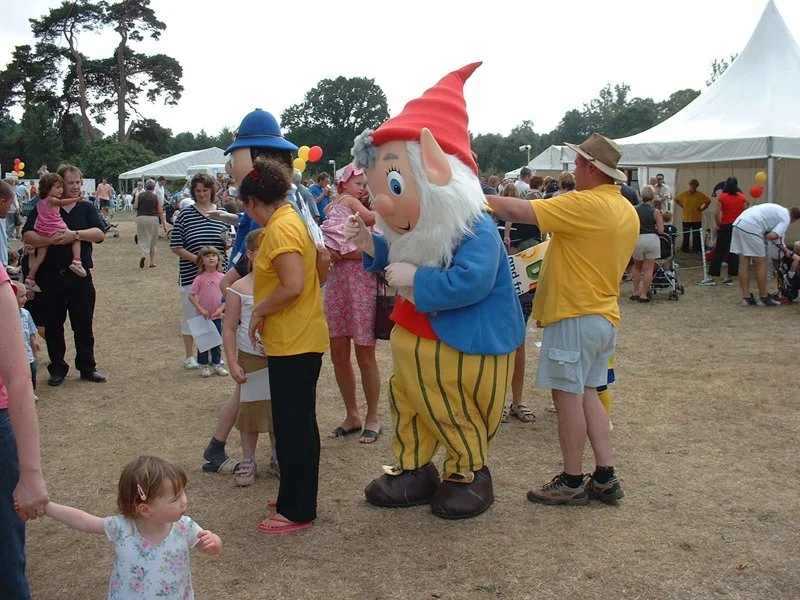
Noddy event at COAM in 2003
Enid Blyton and the Chilterns
Blyton also has strong connections with the local area.
In 1924, she married Hugh Alexander Pollock, and the couple initially lived in a flat in Chelsea before moving to Elfin Cottage in Beckenham in 1926. In 1929, the family moved to Old Thatch in Bourne End, Buckinghamshire, where Blyton lived for almost a decade.
The countryside surrounding her became an important part of her life and provided inspiration for the settings in her stories. Bourne End is particularly associated with Peterswood, the fictional village that appears in The Five Find-Outers series.
In 1938, Blyton and her family moved to Green Hedges in Beaconsfield, a house whose name was chosen by readers through a competition in her magazine. She remained there for the rest of her life, writing many of her most famous books while living in the Chilterns.
An enduring – and changing –legacy
Blyton’s popularity continued long after her death in 1968. In 1982, a survey of 10,000 eleven-year-olds named her their most popular writer, and her books have remained familiar to generations of children.
Her work has also attracted criticism. From the 1950s onwards, some literary critics, teachers, and parents questioned the simplicity of her writing, while aspects of the language, characters and attitudes found in some of her stories have subsequently been criticised as reflecting outdated stereotypes and values. Some later editions have therefore been revised for modern readers.
Despite these debates, Blyton remains the world’s 4th most widely translated author (behind Agatha Christie, Jules Verne and William Shakespeare), and characters such as the Famous Five, Noddy and the inhabitants of the Faraway Tree continue to introduce new generations to her extraordinary world of adventures, mysteries and magical places.
Her long connection with Buckinghamshire also makes Blyton an important part of the Chilterns’ literary heritage. A reminder that this landscape has inspired not only artists and craftspeople, but also some of Britain’s best-known stories for children. Visitors this summer can explore this legacy for themselves through our Magic Faraway Tree trail, inspired by one of Blyton’s most magical and enduring series.