
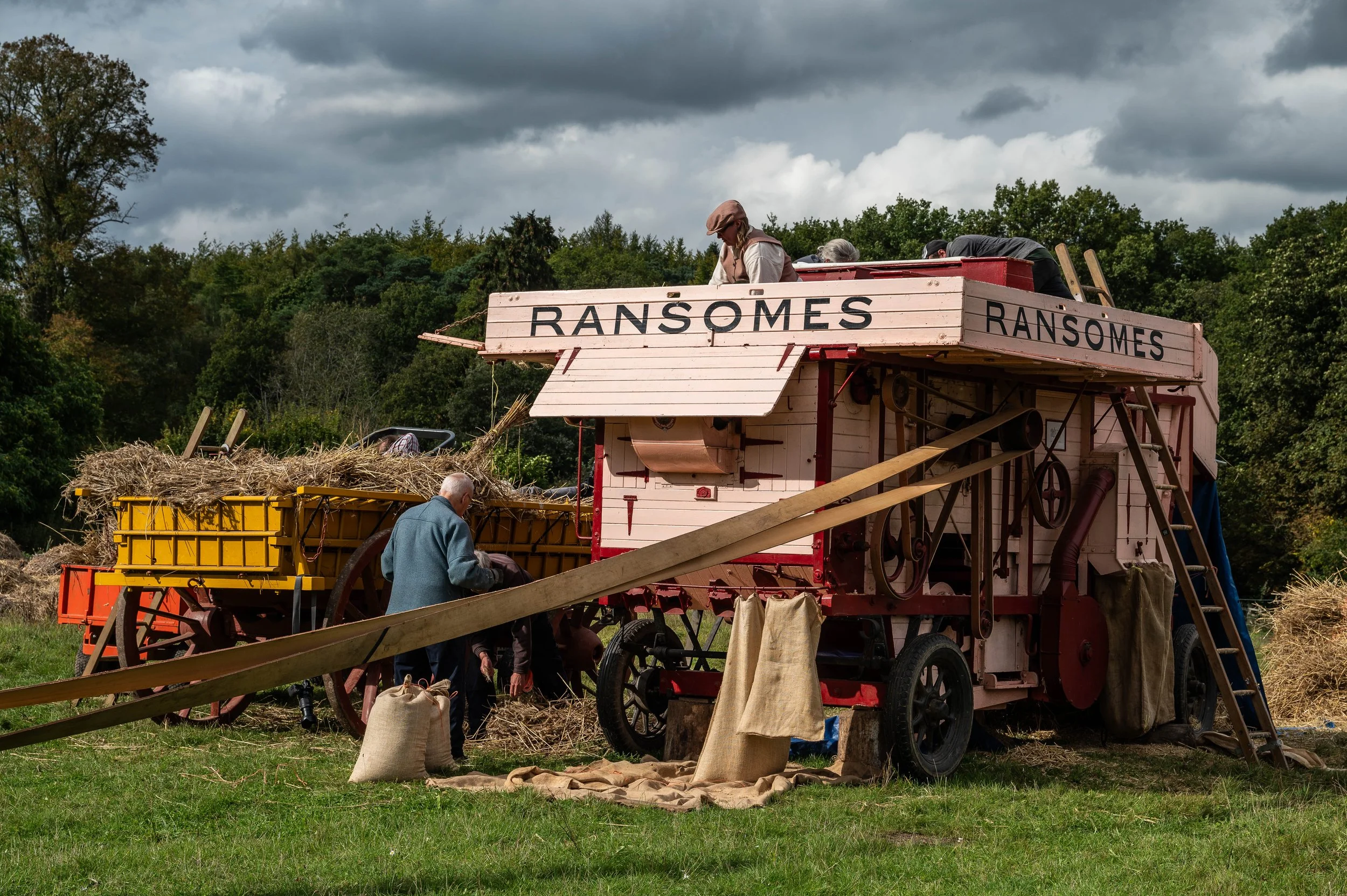
Threshing machine in action
Visitors to COAM during our Harvest weekend may be lucky enough to see our vintage threshing (or thrashing) machine in action. When they were introduced in the early nineteenth century, threshing machines were viewed with suspicion and were one of the triggers of the Swing Riots in 1830. However, once their labour-reducing value quickly became obvious, they were widely found across farmyards for over one hundred years, until they were replaced by combine-harvesters.
From Grain to Harvest
In order to appreciate the importance of threshing machines, we need to begin by understanding the process of threshing. This is the process of separating the grain of a cereal, such as wheat, from its stalk. Without mechanisation, this was achieved by methods such as beating the cereal with sticks or flails to remove the grain from its stalks, leaving a mix of grain, chaff and straw. The straw was picked out by hand, then the grain and chaff needed to be separated, and this was achieved by winnowing.
The Threshing Barn
Winnowing removes the inedible straw and chaff from the grain and was usually carried out by throwing the grain into the air so that the lighter chaff was carried away while the grain fell to the ground, where it could be collected. Often, it was carried out in a specially designed threshing barn, which had a high timber-framed roof and a large threshing floor lying between two opposing sets of large double doors; this design encouraged a cross-breeze, which helped to separate the grain from the straw and chaff. Boards, known as thresholds, were placed across the doorways to keep the grain confined within the building. COAM’s Hill Farm Barn is an example of a threshing barn.
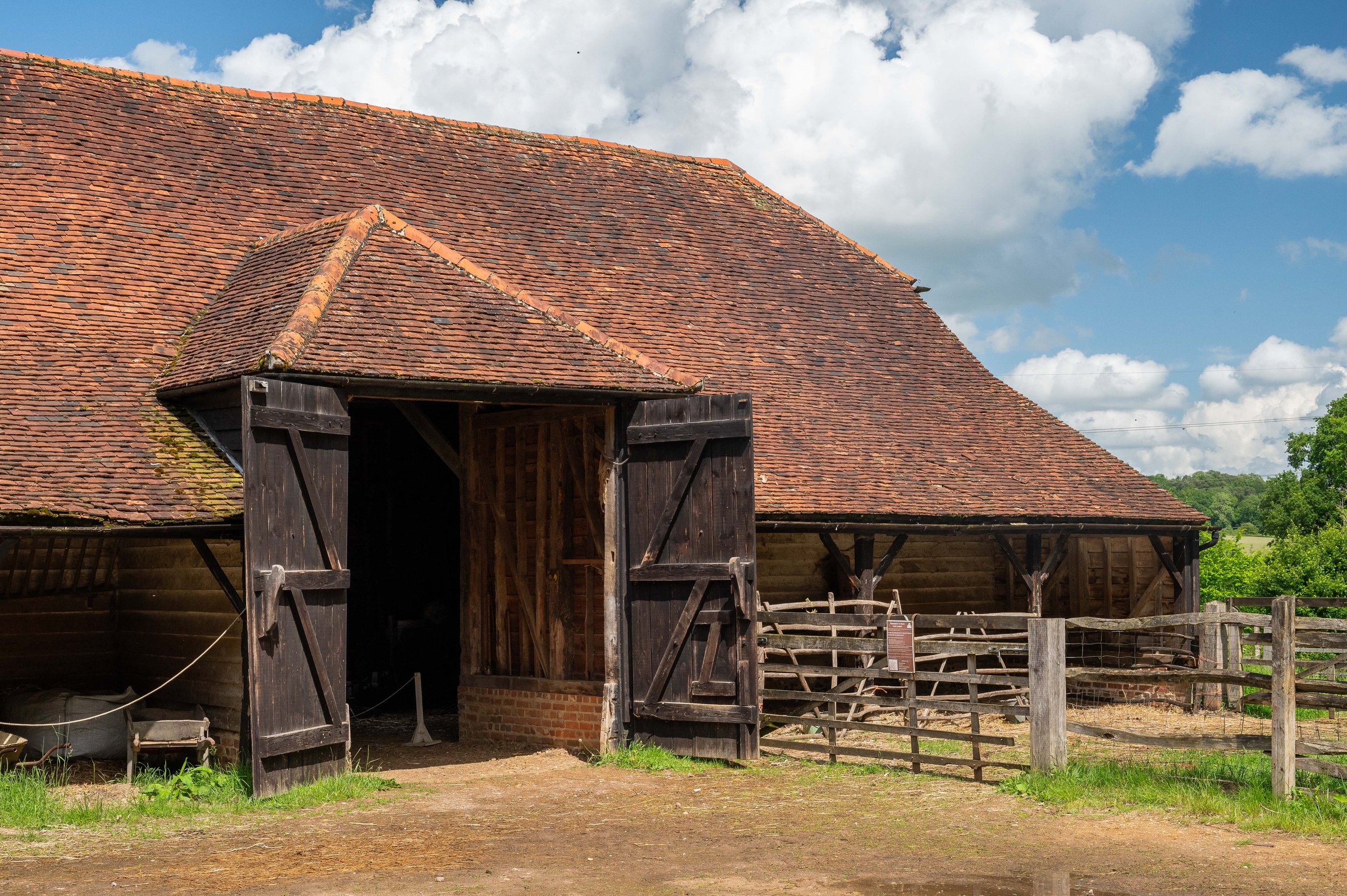
Outside of Hill Farm Barn
The Arrival of the Threshing Machine
Threshing by hand was an extremely laborious process and took up approximately one quarter of agricultural time. The introduction of machines to help with this was, therefore, an important innovation. The first threshing machine was invented in the late eighteenth century by a Scottish engineer, Andrew Meikle. It was a small machine, about the size of a piano, and only performed the initial process of separating the grain from the stalk. However, subsequent modifications meant that the threshing machine could also perform the stages of winnowing and separating the straw.
How a Threshing Machine Works
In a typical design, the harvested cereal crop is fed into the hopper at the top of the threshing machine. It drops down into a space between the beater drums and the concave, a curved wooden frame, where the stems are smashed and separated from the grains. The grain and light materials fall through the concave, while the straw is moved along belts known as straw walkers to the end of the machine; here it is collected for various uses around the farm, such as animal bedding. The grain and chaff are passed up into the elevator and, through a series of fans and blowers, are separated so that the grain can be collected at the front of the machine, while the chaff is blown out of the side.
The separate components of the threshing machine are connected by a series of belts and these were initially driven by horse-power but, later, by steam-power or traction engines or tractors. Separate mechanical reapers and reaper-binders were also developed and these machines all remained in use until they were replaced by combine-harvesters, which combine all of these functions.
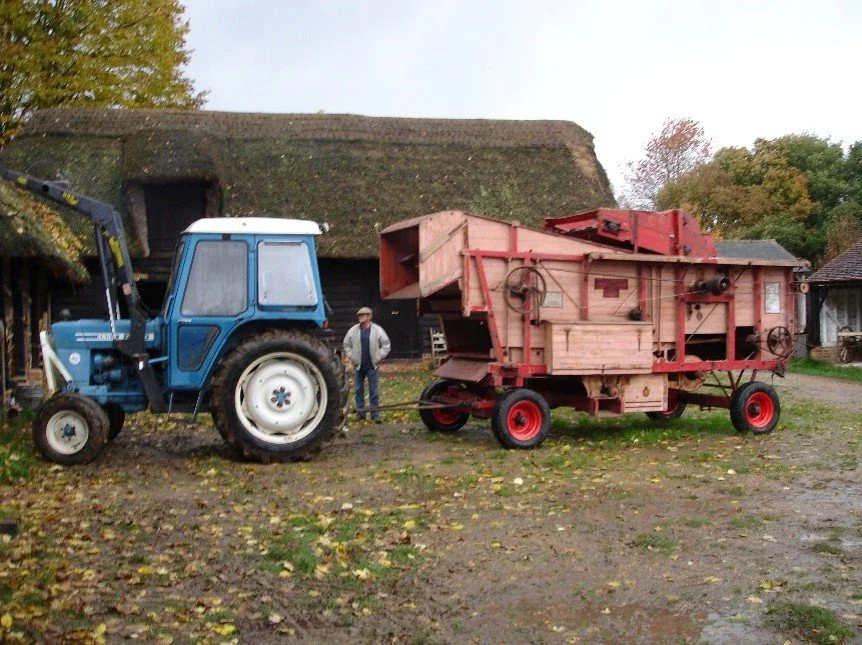
Threshing machine attached to the tractor
COAM’s Ransomes Machine
Our machine, a Ransomes Sims and Jefferies Tractor 54 Thrashing machine, was donated to the museum in 1991 by Philip Buller of Sarratt and, according to its model number, was built in 1947. For machines of this type, manufactured after 1930, the actual year of manufacture can be determined by subtracting 10 from the first two digits of the model number. In this case, the model number is 57294.
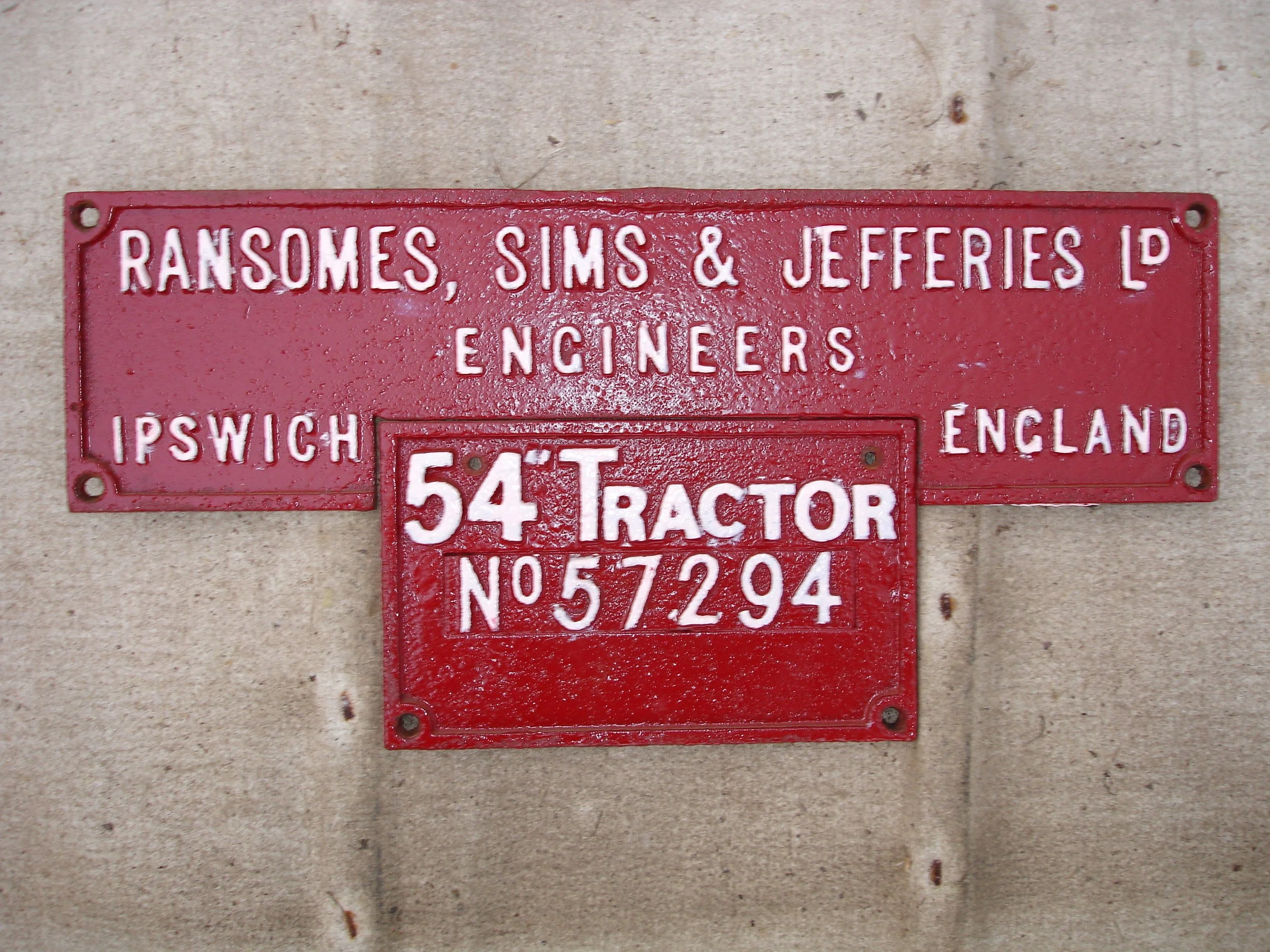
Name and model of the threshing machine
When the museum first tried to run the threshing machine in 1994, it did not work well and so was put in store until 2004 when a major survey and refurbishment project was undertaken. Some of the machine was still in good condition but other parts were weatherbeaten, worn-out and, in the case of the elevator belt, chewed by rats! Once repaired, the thrashing machine was repainted in its original colours of red and pink and the name RANSOMES repainted on the front and sides.
Nowadays, our estates team are proud to be able to demonstrate our thrashing machine once or twice a year, being driven by our 1950 Fordson E27N tractor. It provides a fascinating spectacle and offers an interesting glimpse into farming history.
Watch the Threshing Machine in Action: